Space Objectives
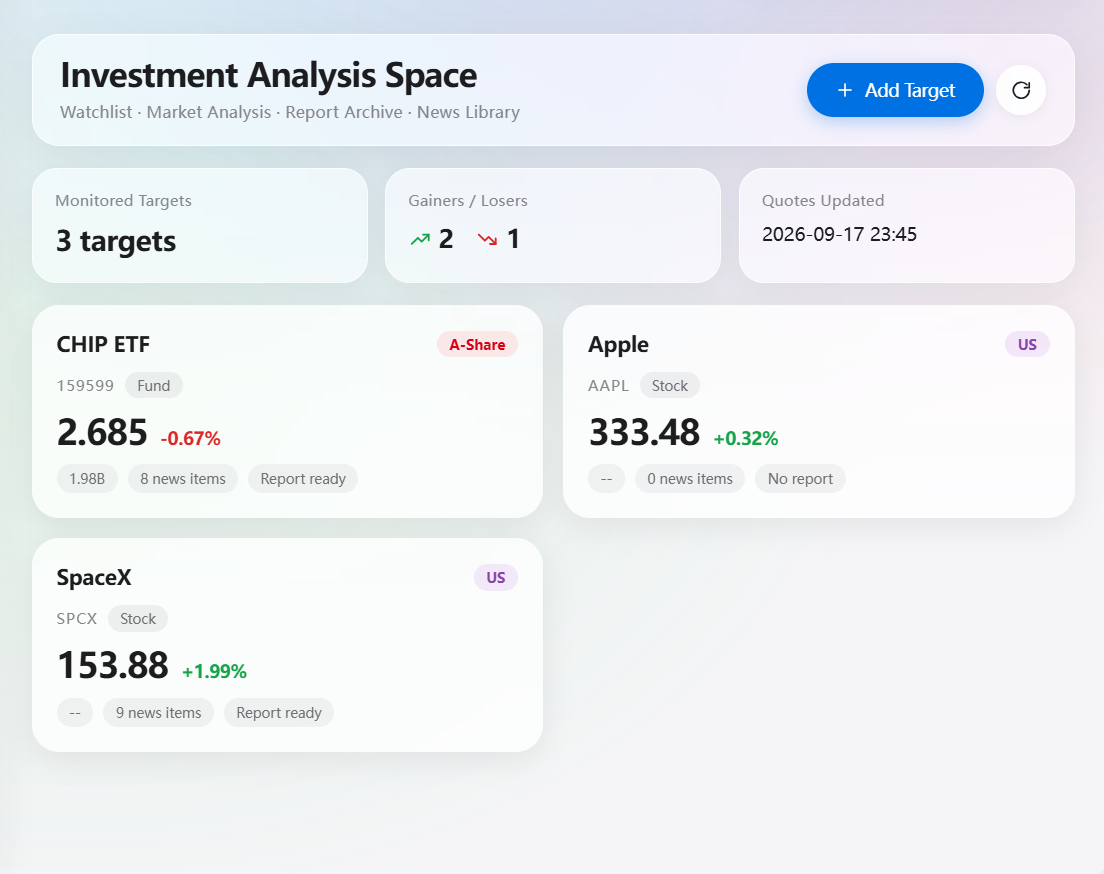
Systematic monitoring plus framework-based research on followed targets (Stock / Index / Fund; A-share / HK / US):
- Long-term monitoring — quote, capital-flow, order-book and K-line tracking for watchlist targets.
- Information accumulation — news, announcements, earnings and market reviews stored as structured entries with tags, source, credibility and verification status; retrievable and traceable.
- Framework analysis — one logically closed-loop report per target via the four-layer framework "data system → credibility assessment → expectation game → scenario simulation"; same-target reports are continuously updated, preserving assumption history and this-round diff.
- Framework introspection — after each analysis, review whether the framework/process needs adjustment and land the change into this file. SPACE.md keeps only the currently effective methodology, never per-round ledgers.
Core philosophy: profit comes not from "what happened" but from the gap between what happened and market expectations. Every conclusion must answer: what is the consensus expectation, how much is already priced in, and where is the expectation gap.
Analysis Method & Process
Baseline: the four-layer framework of the stock-analysis-framework skill. Each analysis runs in this order.
Step Zero — inventory existing assets (mandatory)
- Inspect the live backend/frontend code before acting and resolve the real method names; all data access goes through backend methods, never direct storage mutation.
- If historical reports exist, extract their core assumptions, key tracking indicators and bull/bear chains as the baseline, then define this round's incremental goal (does new data falsify old assumptions? have new flow signals appeared?) instead of redoing everything.
Layer 1 — data & information system (input)
Cover five value tiers: macro & liquidity / industry & supply chain / company fundamentals / market & capital game / alternative & sentiment. Annotate every batch with data type, source, collection time, timeliness, then write it back.
- Split correlated overseas chains — e.g. US chips = compute chain (NVDA/SOX) vs memory chain (SK hynix/Micron), tracked as separate series; merged tracking loses one chain's mapping signal.
- Contract price ≠ spot price — contract is the forward-earnings variable (capacity already allocated), spot is the current-bargaining variable; keep two series so a narrative kill stays distinguishable from an earnings kill.
- ETF/index five-piece set — own K-line + tracking index + same-theme sibling funds + broad-market benchmark + corresponding overseas chain; a fund's own K-line cannot separate a sector move from its own flow.
- Proxy discipline — if the tracking index does not resolve, a single sibling is not acceptable: use at least two, report their dispersion as the proxy-uncertainty band, label the proxy explicitly, and never present it as the tracking index.
- Continuity check before peer comparison — scan peer series for split/conversion breaks (single-day moves beyond ±20%, unstable target/peer price ratio); compute dispersion only inside the split-free window and log the defect.
- Recently-listed targets — pull a window back to the listing date and state price against three anchors (IPO price / post-IPO peak / current); short MAs are structurally incomplete and must be labelled as such.
- Overseas session labelling — read the overseas leg at the latest available intraday snapshot and label every figure with its session (A-share close / US intraday / last completed close); never pair two non-overlapping same-date closes.
- Flow truth order — the disclosed exchange share count is the only trustworthy flow figure; derived shares (Δshares × NAV) are a fallback inference capped at
Partially verified.total_market_capis a scale level only, never a direction. Provider ratio routes share the same lagged share base, so their agreement is a correlated check, not a confirmation. - Never mix flow definitions — NAV-difference "net inflow", sector "main-force net inflow" (an order-flow attribution) and the share-creation proxy measure different things; never add, average or compare them, and always quote the definition beside the number. A rise on above-average volume while shares fall is a turnover event, not an inflow event.
- Theme anchor stock (sixth piece) — when the theme had a pure-play listing within roughly the past quarter, track the new anchor's post-listing path; a listing on the local high is a delivered catalyst, not a fresh trigger.
- Peer set follows the engine, not the legacy sector label — when the incremental narrative and loss pool sit in a different business from the label, track the engine, or the sector attribution and "underperformed its peers" reading will both be false.
Layer 2 — credibility assessment (processing)
Run the five-dimensional filter on every key item: source-motivation screening · cross-verification (two or more independent sources) · fact/opinion/narrative separation · logical consistency · timeliness (sentiment: minutes; earnings: weeks–months; industry logic: quarters). Every write-back carries tags, source URL, credibility (0–100) and verification status.
- Syndicated copies = one source; ≥80 credibility requires genuinely independent originators, ideally one first-hand (filing, company statement, official statistic).
- Contradictory reports — never adopt a headline; settle with primary quote data (close, volume, index level). Published timestamps are unreliable: reconcile them against event content and cap such items at
Partially verified. - Separate the fact from the reading — a leader's statement, a policy document or a plan's headline aggregate is a fact only in its literal text; its demand/money implication is a narrative, upgradable only by first-hand evidence. A multi-year structural document cannot generate same-day orders.
- Missing primary channel — cap every media-only fact at credibility 85, declare the cap, write nothing as
Verified, and discard marketing-only "policy" items. - Supply-calendar arithmetic — test second-hand supply calendars for internal arithmetic consistency; adopt only the direction two independent originators agree on, mark magnitudes unverified, cap 85.
- Price action adjusts weight, never credibility — credibility measures source quality and only a better source can raise it; price evidence may move an item's weight in the conclusion, but only if stated explicitly with the evidence. Price moving against an item is not disproof either.
- Undated items are background, never a trigger — establish the date independently before an item is allowed to explain a same-week move.
- Sign-check every flow metric against the disclosed share change; on disagreement the metric is mislabelled for that day and must be replaced by the share-derived proxy, with the definition clash stated.
- Event-to-session attribution — pin each overseas event to the session actually exposed to it before explaining an A-share move, and benchmark against same-date breadth before calling a decline sector-specific.
Layer 3 — expectations & game (analysis)
- Judge already priced in vs potential expectation gap, and compare with Space history: did the last gap pay off? where is pricing versus history?
- Profile five capital groups — institutions, northbound, hot money, quant, retail: expectation source, behaviour pattern, tracking signal.
- Deduce the expectation-change path and answer: good news exhausted? prisoner's dilemma? reversal signals?
- Right-side confirmation needs hard evidence — volume back above roughly the 5-day average plus two consecutive closing verifications; single-day technicals stay "pending" and never move the stance.
- Falsification is symmetric — a high-volume surge fading to a red close, or a shrinking-volume stall closing below a key line, lowers the stance rather than being passively waited out; upgrades (including bottom-fishing) need the same two-day closing verification.
- "Good news priced in" is a top signal — when a delivered catalyst's new high fails to hold two consecutive closes, treat it as falsification evidence, not a fresh trigger; corroborate via the overseas chain (the segment that made the high first leads the reversal). If the domestic target keeps falling while the overseas bellwether only consolidates, name the extra local (supply/positioning) component.
- Attribution discipline — every verdict states the move's nature (valuation kill / earnings kill / narrative kill) and the leading variable, then turns that attribution into a falsifiable assumption in Layer 4; benchmark against a broad-market proxy and same-theme peers.
- Cross-session clock — the two-day rule counts only sessions actually exposed to the shock; a catalyst after the A-share close — including scheduled events such as FOMC — resets the clock, so a high-volume rally into a known event is pre-event positioning, not day 1. A shrinking-volume hold is never itself confirmation; never read an event-day gap in either direction as confirmation.
- Imported vs locally funded advance — an advance roughly 1:1 with the overnight overseas move, without a rise in fund shares and on below-average broad-market volume, is a beta catch-up: it can complete a technical reclaim but cannot by itself complete a right-side confirmation. Require net share creation before raising the stance, and state in the report which type the session was.
- Core question: who is buying/selling right now, on what story — will that story attract more money later, or is it solid enough for the smartest money to hold long-term?
Layer 4 — scenario simulation & risk (decision)
- Holographic picture: fundamental trend, expectation position, investor structure, 1 main contradiction + 2–3 key variables.
- Optimistic / neutral / pessimistic scenarios plus a risk matrix with four damage branches: valuation kill (discount rate) · earnings kill (realised results) · narrative/logic kill (the demand premise itself is attacked) · liquidity drain (IPO/unlock/in-kind supply, or a fresh anchor absorbing turnover). A narrative kill reprices terminal demand and ends only when the narrative is repaired or falsified — "it is cheap" is not a reason to buy. A liquidity drain looks like a valuation kill but is not repaired by a discount-rate turn, so name it separately.
- Coincident supply sources — when scheduled (unlock, expiry) and unscheduled (in-kind distribution, block, new anchor) supply land together, the drain branch is dominant for that horizon and its pessimistic probability must be raised explicitly and quantified, with exit conditions written against supply and volume. Symmetric rule: demonstrated absorption of already-released tranches weakens the drain branch.
- 3–5 falsifiable core assumptions with exit/correction conditions; any falsification means unconditional execution by discipline.
- Exit thresholds on a closing-price basis for premise-level shocks (a shrinking-volume break counts as valid); record the intraday low separately so a gap-driven breach is not mistaken for a confirmed close below.
- Contract-price triggers are written on the revision direction, not the level — "forecast revised up/down versus previous consensus", recording old and new ranges with dates; a level can keep decelerating while the forecast is revised upward, which is still a positive expectation gap.
- Decompose aggregate flows by sub-theme and by fund before naming a sector-wide drain, and state whether the flow is uniform or rotational; rotation is flow-side evidence for relative strength but does not repair the held fund's own drain.
- List future observation nodes and the expected direction of each capital group's expectation revision at each node (resonance or divergence).
Step 5 — persist & update (mandatory)
- Save raw data/information as content entries with tags, related target, source URL, credibility, verification status and publish time.
- Update the existing report rather than creating a new one, keeping "assumption history comparison + this-round diff" (which assumptions were verified/falsified, whether the expectation gap paid off).
- Sync the tracking-indicator list (additions, removals, threshold changes) into the report and subsequent tags.
Execution notes: compute price/volume metrics through the Space-side digest wrappers instead of re-deriving by hand; validate any aggregated confirmation counter against a manual recomputation of the last sessions, and report the actual window the data source returned. Live code wins — when this document names an interface the running code does not expose, resolve the real name before calling and record the divergence as a process gap instead of inventing one.
Before output — full-chain self-check
Data cross-verified and written back → consensus expectation and degree already priced in for reliable facts → which capital group acts first on the gap → what chain reaction follows (resonance or calling each other fools) → which time points and events confirm or falsify the transmission chain → decision: bet / wait / exit. Every report carries a disclaimer: research-framework output only, not investment advice; fabricating data is forbidden and unobtainable data must be declared as an explicit gap.
Post-analysis Framework Review (mandatory closed loop)
After each analysis is written back, review "does the framework/process need adjustment" against this five-layer checklist. SPACE.md keeps only currently effective methodology, never per-round records.
- Data layer — collection dimensions sufficient? high-frequency indicators or sources to add/remove?
- Credibility layer — which filter step failed; a source or information type misjudged; fact/opinion/narrative labelling gaps?
- Game layer — deviation between last round's expectation-gap judgment and actual price action: framework gap or execution deviation? which participant patterns need correction?
- Scenario layer — which core assumptions were falsified? which risks were not covered in advance? do exit/correction thresholds need adjustment?
- Process & tools — interface/wrapper gaps; content field structure, report template and tracking-indicator list evolution.
Dispositions: needs adjustment → land the clause change into the corresponding "Analysis Method & Process" section with its effective date, and sync related code so docs and code stay consistent · re-checked, no adjustment → this document is unchanged; state the conclusion in the report · pending observation → record it in the target's observation list or entry tags for priority re-check next round.
Methodology clauses carry effective dates "(YYYY-MM-DD)" for traceability; target-level market action, assumption verification and per-stock observations always stay in reports and content entries.
Business Rules (must not be broken)
- All Space data reads/writes go through backend methods; wrap a missing method first, never bypass or mutate storage during analysis.
- Never fabricate data — every cited figure carries source and collection time; unobtainable data is declared as a gap.
- Content entries require a non-empty title and body, at least 1 tag, credibility within [0,100] and an http(s) source URL;
Verifiedrequires a source URL. - Same-target reports are overwrite updates preserving assumption history and diff — never duplicates.
- Framework review is a closed loop — completed after every analysis, no per-round ledgers, never skipped.
- Deleting a monitored target cascades its report and the content entries associated only with it; confirm before operating.
- Detail snapshots are best-effort: record failure reasons and degrade rather than filling fake data; capital flow and order book apply to stocks only.
- Enum values (security type, scope/credibility/time filters, verification status, update mode, priority) use the English canonical forms; legacy Chinese values are auto-normalized on read and must keep working.
- All outputs are research references, not investment advice; market risk and decisions remain the user's own responsibility.